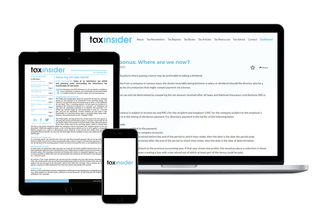
 DIGITAL
- Instant access to 1432 digital articles
- Downloadable PDFs
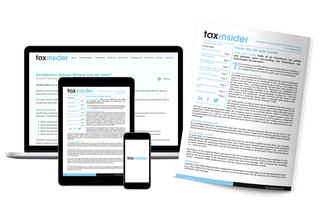 DIGITAL + PRINT
- Instant access to 1432 digital articles
- Downloadable PDFs
- Print copy delivered monthly
-
Suitable for all business typesLtd companies, sole traders & partnerships
-
Digital format (or add print too)Whatever your preference, you've got it
-
Published every monthSo you're always kept up to date
-
90-day money back guarantee100% of your money back, no quibble
-
Instant back catalogue accessOver 1432 articles to help you save tax
-
No commitmentNo minimum tie-ins, cancel anytime
Written by leading UK tax professionals
Every article, tip and strategy in Tax Insider is written and reviewed by practising accountants, Chartered Tax Advisers and specialist tax consultants, including contributors such as Mark McLaughlin, Peter Rayney and Malcolm Finney. You're getting advice from people who advise real clients on real tax problems, not generic guidance.
New articles published
in October 2026
-
The Pension IHT Shelter Ends in April 2027: Time to Rethink
I once heard someone say: “My house is for my retirement; my pension is for the kids.” They were broadly saying that, as pensions are not included in an individual’s inheritance tax (IHT) estate, it makes sense to spend taxable assets first – particularly the equity they had built up in their house – and preserve the pension, largely untouched, to pass on free of IHT.
This encapsulated the general logic of estate planning for many years. However, from April 2027, that logic changes.
Tristan Noyes suggests what should be considered when pensions lose their inheritance tax exemption from April 2027."
 HMRC Enquiry Dragging On? Can You Force It to Close?
Individuals who file self-assessment returns are generally open to enquiries into their tax returns by HM Revenue and Customs (HMRC).
In addition to those tax returns which are selected by HMRC for a particular reason (e.g., unexplained, significant decreases in self-employment income), a ‘very small proportion’ of tax returns are randomly selected for an enquiry (see HMRC’s Enquiry Manual at EM0093).
It is therefore useful to know how tax return enquiries normally operate, including the rules around how and when HMRC may open and close an enquiry.
Mark McLaughlin looks at HMRC tax return enquiries and applications by taxpayers to the tax tribunal for a direction that HMRC must close an enquiry.
 Employee or Self Employed: What Can You Claim for Working From Home?
Certainly since COVID, it has become increasingly common for employees to work from home – either permanently or as part of flexible working for employees; however, the self-employed will often use their homes as offices too.
Chris Thorpe considers the income tax rules on working from home. Insurance Claims and VAT: The Gap That Costs Businesses
When a business suffers a loss and makes an insurance claim, the insurance company will ask if the business is VAT registered. The normal position is that if the business is VAT registered, the insurance company pays net of the VAT. The business then claims the VAT element from HMRC on its next VAT return. If the business is not VAT registered, the insurance company pays the full amount of the claim, including the VAT.
Andrew Needham looks at the VAT position of insurance claims and what happens when a business cannot recover all its VAT.
-
Art, Antiques, and Jewellery: Are Your Gains Taxable?
Chattels are tangible, movable personal property (e.g., art, antiques, jewellery and furniture). For capital gains tax (CGT) purposes, they are split into wasting chattels with a predictable life of 50 years or less, which are usually exempt and non-wasting chattels with a life of over 50 years, which are potentially taxable if sale proceeds exceed specific monetary thresholds.
In legal and estate definitions, ‘plate’ (silverware, goldware, or solid metal utensils or ornaments) is explicitly listed alongside items like jewellery, linen, and furniture as a personal chattel.
Jon Golding outlines capital gains tax asset exemptions that exist in respect of chattels and some of the quirks.
 Section 144 Will Trusts: The IHT Lifeline Families Overlook
HM Courts & Tribunals Service statistics show that from approximately 580,000 deaths a year in England and Wales, 125 probate cases were formally contested in the High Court in 2024. Many more would be heard but for inheritance tax (IHT) provisions in IHTA 1984, s 144.
Whatever the reasons for any contest, a section 144 discretionary will trust is one of the most relied upon provisions available to families and their advisers should an individual’s will not turn out to be practical or tax-efficient or if, when the will is drawn up, the testator is unsure whether to bequeath certain assets to particular beneficiaries.Jennifer Adams considers the benefit of a discretionary will trust under specific inheritance tax legislation and circumstances in which such a trust could be used.
 HMRC Enquiries: A Practical Guide to Getting Through One
A letter from HM Revenue and Customs (HMRC) to check your tax affairs can be worrying. The word ‘enquiry’ suggests that something has gone wrong, but this is a way for HMRC to ensure that all income and gains have been declared, the correct reliefs claimed and the proper amount of tax paid.
However, enquiries into such matters by HMRC should not be ignored or treated casually. HMRC has formal powers to ask questions, request records and, in some cases, charge penalties if information is not provided. The best approach is to be calm, organised and prompt. A well-handled enquiry is often resolved more quickly and with less stress.
Richard Curtis outlines the basic considerations when dealing with an HMRC enquiry.
-
Q&As with Arthur Weller
Some of our most popular articles
-
Tax implications of awarding shares to family members
The employment-related securities legislation deals with arrangements involving shares and securities provided by reason of employment where the full value of the employment reward provided to the employee is not included in the salary package and is charged to tax.
Jennifer Adams considers the tax implications of shares in a family company being awarded or gifted to family members of employees.
- Decisions, decisions! Partnership or limited company?
A sole trader looking to expand their business might be weighing up the ‘pros’ and ‘cons’ of a partnership or a limited company. They are very different, with not only very different tax consequences, but functions as well.
Chris Thorpe looks at partnerships and companies and considers which business model might be best.
 Don’t write off your chances of tax relief!
Under the loan relationships rules for companies, debits on loan arrangements are not deductible for corporation tax purposes in some circumstances.
Kevin Read highlights a recent case concerning the loan relationship rules for companies.
-
Who has tipped HMRC off?
When HM Revenue and Customs (HMRC) opens a tax return enquiry, the natural reaction of most taxpayers is to speculate about the reason why their tax return has been selected. In fact, HMRC does not need an excuse to open a tax return enquiry; a small proportion of tax returns are simply selected at random. .
Mark McLaughlin looks at whether a taxpayer can find out if an HMRC enquiry has been opened as the result of an accusation made by a third party.
-
Remuneration in 2024/25 - Important Considerations
When considering the tricky matter of remuneration planning, there are two things to consider; the amount of remuneration, and what form it takes.
Chris Thorpe looks at what to watch out for with regard to paying employees and directors.
- Alternative ways of paying staff tax-efficiently
Despite the reduction in National Insurance contributions (NICs) in Spring Budget 2024, more employees are paying tax at higher rates on their earnings due to the freezing of tax thresholds. Some may find that any pay rise or bonus attracts additional tax and NICs such that the net pay increase is minimal.
Jennifer Adams looks at some alternatives to rewarding an employee with a pay rise or a bonus.
-
A popular ‘exit’ strategy when a shareholder is retiring
Mark McLaughlin looks at company purchases of own shares and warns not to become too focused on the more difficult rules for capital treatment.
A company purchase of its own shares from a shareholder is a popular ‘exit’ strategy when an individual shareholder is retiring, or a dissenting shareholder is departing.
-
Q&As with Arthur Weller
Subscription Benefits
We asked our subscribers what they love about Tax Insider.
These are the top 7 reasons that they gave us:
Monthly Newsletter
DIGITAL
- Instant access to 1432 digital articles
- Downloadable PDFs
DIGITAL + PRINT
- Instant access to 1432 digital articles
- Downloadable PDFs
- Print copy delivered monthly
-
Suitable for all business typesLtd companies, sole traders & partnerships
-
Digital format (or add print too)Whatever your preference, you've got it
-
Published every monthSo you're always kept up to date
-
90-day money back guarantee100% of your money back, no quibble
-
Instant back catalogue accessOver 1432 articles to help you save tax
-
No commitmentNo minimum tie-ins, cancel anytime
Tax Insider…