 DIGITAL
- Instant access to 840 digital articles
- Downloadable PDFs
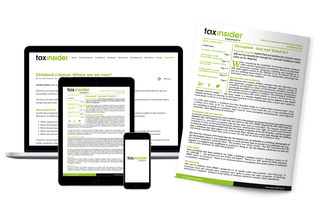 DIGITAL + PRINT
- Instant access to 840 digital articles
- Downloadable PDFs
- Print copy delivered monthly
-
Suitable for all business typesLtd companies, sole traders & partnerships
-
Digital format (or add print too)Whatever your preference, you've got it
-
Published every monthSo you're always kept up to date
-
90-day money back guarantee100% of your money back, no quibble
-
Instant back catalogue accessOver 840 articles to help you save tax
-
No commitmentNo minimum tie-ins, cancel anytime
Written by leading UK tax professionals
Every article is written and reviewed by practising accountants, Chartered Tax Advisers and specialist property tax consultants, including contributors such as Mark McLaughlin and Malcolm Finney. You're getting advice from people who advise real landlords and property investors on real tax problems, not generic guidance.
New articles published
in October 2026
-
Investor or Trader: The Line That Pulls IT, CGT, and IHT Apart
Many property tax questions boil down to one key principle: was the property bought to keep, or bought to sell? A client who buys a flat and lets it for a decade is an investor. One who buys the same flat, refurbishes it and sells within months is very probably a trader. The asset is identical but the intention at acquisition leads to a very different tax analysis.
Parliament has never defined a trade beyond providing that it includes any venture in the nature of trade (ITA 2007, s 989). We therefore rely on jurisprudence, and HMRC lists nine resulting badges of trade at BIM20205 of its Business Income Manual: the profit-seeking motive, the number of transactions, the nature of the asset, the existence of similar trading transactions, changes made to the asset, the method of sale, the source of finance, the interval between purchase and sale, and the method of acquisition.
Nick Wright considers the boundary between property dealing and property investment, the badges of trade that police it, and why the classification now pulls income tax, capital gains tax and inheritance tax in different directions. -
Waiving Salary or Dividends? Have You Thought About IHT?
There are several personal tax reasons why a company owner might wish to waive (i.e., in broad terms, relinquish) their right to a salary or dividend. Those tax reasons commonly revolve around income tax (e.g., to prevent total income being pushed into higher rates, and possibly losing their personal allowance).
Mark McLaughlin looks at the waiver of salary and dividends in an inheritance tax context.
-
April 2027 Tax Rises Ahead: Can You Move Rental Income to a Family Member?
Although the price tag on extra income is predictably tax, when the result is exposure to higher tax rates or even a reduction in net income overall, individuals tend to take notice.
In this context, the April 2027 property tax changes may be the catalyst which galvanises landlords to consider whether they want to offload excess property income to a worthy recipient, such as a family member with a lower income profile. But how can this be achieved tax-efficiently?
Debbie Reyland looks at how to transfer rental income effectively without falling into the many tax traps, ahead of the April 2027 tax increases.
-
Interest Relief on Your Home: The Route Most Owners Don't Know About
The days of MIRAS (mortgage interest relief at source) are long gone, and the general rule is that tax relief is not available for interest on a loan to buy a main residence. However, there are exceptions, and if you have at least one investment property as well as your main residence, it is possible to finance the let property in such a way as to obtain relief for the interest that you pay on the mortgage on your main residence.
Further down the line, it may also be possible to release equity from a let property to clear the mortgage on a main residence while securing interest relief.
Debbie Reyland looks at how to transfer rental income effectively without falling into the many tax traps, ahead of the April 2027 tax increases.
-
Q&As with Arthur Weller
Some of our most popular articles
 Joint property letting vs partnerships
Property partnerships seem popular these days – typically, as a stepping-stone to greater things. Regular readers will know that I have long criticised HMRC’s published position on whether a property partnership exists, as distinct from simply co-owned property. My argument is that HMRC has drawn up its guidance to set an unreasonably high threshold to ‘make the grade’ as a partnership.
Lee Sharpe looks at whether a joint property letting activity amounts to a partnership, and why it is relevant to landlords.
 Main residence relief and multiple residences
Most people do not expect to have to pay capital gains tax (CGT) when they sell their home. Private residence relief (also known as main residence relief or principal private residence relief) normally applies in full when the property has been the taxpayer’s only or main residence throughout the whole period for which they have owned it.
Sarah Bradford outlines the concept of a ‘main’ residence for capital gains tax purposes.
- That old boiler: Repairs or improvement?
The government (HMRC) has become increasingly worried about the volume of small and medium-sized enterprise research and development (R&D) tax credit payments where a company claims to have undertaken eligible R&D activity (and it is important to keep in mind that only certain types of R&D may qualify – there are a lot of criteria).
Lee Sharpe looks at tax aspects of modernising property and the risk of disallowance as improvements that constitute capital expenditure, losing income tax relief in the property business.
 Investing in commercial property: Tax implications
Whether to buy commercial or residential property depends on various factors, not least the more beneficial tax system for commercial lets and whether an individual or a company is purchasing the property. The government wishes to encourage commercial lets and therefore permits a more generous tax regime than residential lettings.
Jennifer Adams considers some important tax benefits of investing in commercial property.
-
Q&As with Arthur Weller
Subscription Benefits
We asked our subscribers what they love about Property Tax Insider.
These are the top 7 reasons that they gave us:
Monthly Newsletter
DIGITAL
- Instant access to 840 digital articles
- Downloadable PDFs
DIGITAL + PRINT
- Instant access to 840 digital articles
- Downloadable PDFs
- Print copy delivered monthly
-
Suitable for all business typesLtd companies, sole traders & partnerships
-
Digital format (or add print too)Whatever your preference, you've got it
-
Published every monthSo you're always kept up to date
-
90-day money back guarantee100% of your money back, no quibble
-
Instant back catalogue accessOver 840 articles to help you save tax
-
No commitmentNo minimum tie-ins, cancel anytime
Property Tax Insider…