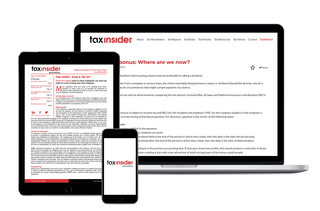
 DIGITAL
- Instant access to 751 digital articles
- Downloadable PDFs
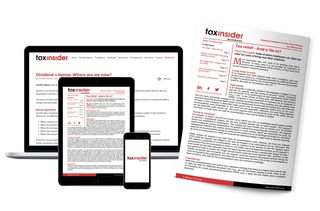 DIGITAL + PRINT
- Instant access to 751 digital articles
- Downloadable PDFs
- Print copy delivered monthly
-
Suitable for all business typesLtd companies, sole traders & partnerships
-
Digital format (or add print too)Whatever your preference, you've got it
-
Published every monthSo you're always kept up to date
-
90-day money back guarantee100% of your money back, no quibble
-
Instant back catalogue accessOver 751 articles to help you save tax
-
No commitmentNo minimum tie-ins, cancel anytime
Written by leading UK tax professionals
Every article is written and reviewed by practising accountants, Chartered Tax Advisers and specialist business tax consultants, including contributors such as Peter Rayney and Mark McLaughlin. You're getting advice from people who advise real businesses on real tax problems, not generic guidance.
New articles published
in October 2026
 Failed Business Investment: Lose the Money and the Tax Relief Too?"
No rational individual would invest in a business in the hope or expectation of losing their money. However, despite the best of intentions, the business may still fail.
It might be possible to at least salvage some tax relief. For example, loss relief may be available for income tax purposes where the individual’s shares have become worthless, if certain conditions are satisfied, such as where enterprise investment relief is attributable to the shares, or where the shares are in a ‘qualifying trading company’ and have been subscribed for by the individual (ITA 2007, s 131). A claim would also be required that the value of the shares had become negligible for capital gains tax (CGT) purposes (under TCGA 1992, s 24).
Mark McLaughlin warns that in some cases not only might a business investment be lost, but also any tax relief for the loss.
 Family Investment Companies: Worth the Long Game?
This final article in a five-part series considers the double taxation problem on extraction, the wealth threshold at which family investment companies (FICs) make sense, and the long-term risks that every adviser must confront.
Nick Wright considers whether family investment companies deliver genuine tax efficiency over the full lifecycle.
 Salary or Dividends: Which Works Better for You?
A company is a separate legal entity distinct from the shareholders who own it. This means that where a business is operated through a personal or family company, the profits must be extracted if they are to be used personally outside the company.
There are various ways of extracting profits, including taking a salary and paying dividends. Here, we take a look at the tax implications of each.
However, it should be noted at the outset that these are not the only ways of extracting profits, and there is no ‘one-size-fits-all’. The optimal approach will depend on the individual’s personal circumstances.
Sarah Bradford looks at the merits of extracting profits from a personal or family company in the form of salary or dividends.
-
The 5% Summer VAT Rate: What It Covered and How It Worked
Legally, the reduced VAT rate of 5% was implemented by SI 2026/576. It introduced two new groups into Schedule 7A of VATA 1994: group 17 makes provision for the supply of children’s meals; group 18 is considerably wider in scope and covers the admission to various events and facilities.
Fabian Barth examines the main features of the temporary reduced VAT rate of 5% which was in force in the UK throughout the summer.
-
Q&As with Arthur Weller
Some of our most popular articles
- Extracting profits from your personal or family company
A company is a separate legal entity, distinct from the shareholders that own it. Consequently, if the directors and shareholders want to use the profits made by the company for their personal use, they will need to extract those profits first. There are various ways in which this can be done; some are more tax-efficient than others.
Sarah Bradford considers options for extracting profits from a company in a tax-efficient manner in the 2024/25 tax year.
 Is HMRC playing ‘dividend detective’?
HMRC recently undertook a ‘One to Many’ letter campaign, wherein HMRC’s skilled data analysts undertake to mine nuggets from a huge range of sources to test for omissions or errors in tax returns.
Lee Sharpe reports on HMRC getting all ‘Nancy Drew’ with its sleuthing over company reporting and shareholders’ dividend income returns.
-
A little known but generous CGT relief
Some company shareholders may either be unaware or have forgotten about a relatively unknown capital gains tax (CGT) relief that offers a reduced CGT rate of only 10% on qualifying gains of up to £10m during their lifetime, if certain conditions are satisfied.
Mark McLaughlin highlights a relatively unknown and infrequently used but generous capital gains tax relief.
-
Extraction point: Extracting profits on cessation
Owner-managers can spend a significant amount of time and energy building a successful and profitable trading company.
Joe Brough looks at tax issues for business taxpayers and their tax advisers when a company is coming to an end.
-
Q&As with Arthur Weller
Subscription Benefits
We asked our subscribers what they love about Business Tax Insider.
These are the top 7 reasons that they gave us:
Monthly Newsletter
DIGITAL
- Instant access to 751 digital articles
- Downloadable PDFs
DIGITAL + PRINT
- Instant access to 751 digital articles
- Downloadable PDFs
- Print copy delivered monthly
-
Suitable for all business typesLtd companies, sole traders & partnerships
-
Digital format (or add print too)Whatever your preference, you've got it
-
Published every monthSo you're always kept up to date
-
90-day money back guarantee100% of your money back, no quibble
-
Instant back catalogue accessOver 751 articles to help you save tax
-
No commitmentNo minimum tie-ins, cancel anytime
Business Tax Insider…