AI and the Future of Tax: Key Trends and Strategies
How AI works, how HMRC and other tax authorities use it, and how accountants and tax advisers can manage its risks, ethics and governance in practice.
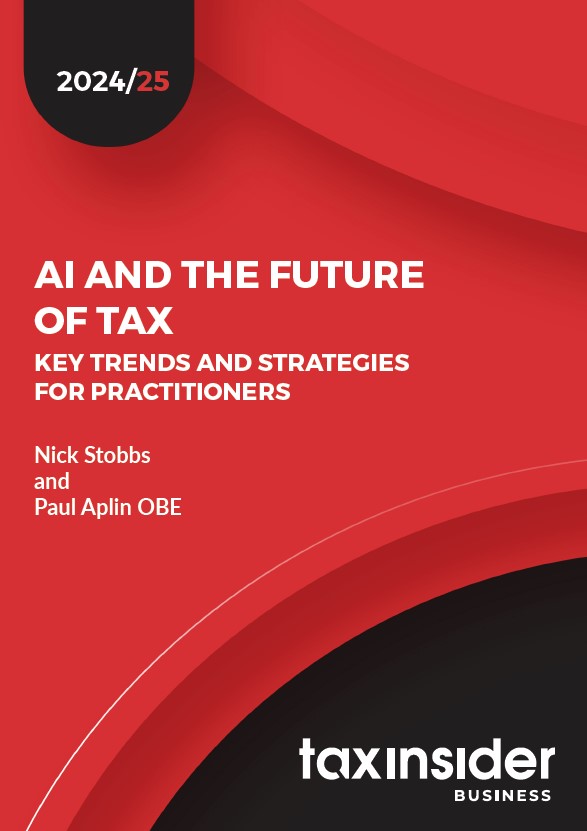

New Report For Tax Practitioners
AI for Accountants and Tax Advisers
By Nick Stobbs and Paul Aplin OBE
Artificial intelligence (AI) is already changing the world of tax. HMRC and other tax authorities use it to answer taxpayer queries and to identify tax risk, bookkeeping and accounting software uses it to categorise transactions, and since ChatGPT hit the headlines in November 2022, almost everyone in tax and finance has heard of generative AI. But how do you separate the hype from the reality?
Written with practitioners in mind by Nick Stobbs, co-founder of AI company Tax on Demand, and chartered accountant and chartered tax adviser Paul Aplin OBE, this guide explains what AI is, how it is being employed in tax and how it is likely to be used over the next few years. It also tackles the practical questions firms face: the risks and how to mitigate them, the ethical issues, the governance to put in place, and what AI means for recruitment, clients and fees.
What Is AI and How Does It Work?
Artificial intelligence is the field of computer science dedicated to developing machines and software that can perform tasks typically requiring human intelligence, such as recognising speech, making decisions and solving problems. Machine learning is a subset of AI in which algorithms learn from data rather than being programmed for every scenario, and deep learning is a more advanced form that uses neural networks with many layers.
Generative AI goes a step further. Rather than classifying or predicting, it creates new content, such as text, images or computer code, and it can answer questions asked in natural language. The difference between traditional (predictive) AI and generative AI is commonly described as predictable and reliable versus creative and flexible.
AI in Tax Practice: Risks and Opportunities
Generative AI does not understand the material it is trained on in the usual sense of the word. It generates a plausible answer rather than the right one, and it can sometimes get the answer completely wrong, which is known as "hallucination". In F Harber v HMRC [2023] UKFTT 1007 (TC), an unrepresented taxpayer cited nine cases found via generative AI to support her appeal against a tax penalty; all of them were entirely fictitious.
Firms also need to manage data security and confidentiality, cybersecurity and possible breaches of copyright, and questions about the use of AI have started to appear in PI policy renewal documentation. As the CIOT and ATT point out, a member remains ultimately accountable for the work, even where AI has been used. Yet the authors’ view is that the future for practitioners is renaissance rather than redundancy: the risks must be understood, but the opportunities are huge.
What This Report Covers
In two chapters, with nine practical points for firms and insights from contributors at ICAEW, CIOT, ACCA, PwC and other organisations, the report covers:
- The power and promise of artificial intelligence (AI)
- Defining key AI concepts
- A journey through AI history
- Understanding AI categories
- Generative AI – Why it’s taking the world by storm
- AI and Ethics: Striking a balance
- The future of AI: What lies ahead?
- AI in the world of tax
- Introduction to AI in tax
- How tax authorities are embracing AI
- AI’s impact on tax stakeholders
- AI’s transformative influence on the accounting profession
- Ethical implications in AI-driven tax
- Practical changes in the tax profession
- A changed profession: Extinction or renaissance?
- And so much more.
How AI works, from machine learning to generative AI
The first chapter explains the key concepts in plain terms, from machine learning and deep learning to foundation models, large language models (LLMs) and the transformer technology behind them. It traces AI’s history from Aristotle to the launch of ChatGPT, sets out the risks of AI and how to address harmful outputs, and looks ahead to synthetic data, multimodal AI, reinforcement learning and AI agents.
Using generative AI safely and getting reliable answers
Why the training data cut-off date matters in tax, and how prompt engineering, prompt libraries, the "temperature" setting, retrieval augmented generation (RAG) and fine-tuning can improve accuracy. The report also explains why firms should experiment safely without client data, review results and set standard procedures, and check whether a secure version of a model is available so that confidential data is not shared outside the organisation.
How HMRC and other tax authorities use AI
Drawing on the OECD’s Tax Administration 2023 report, the guide looks at AI-powered digital assistants, including HMRC’s chatbots, and at how tax authorities use AI to detect risk. Examples include HMRC’s VAT predictive analytics model and its Connect system, which compares declared income with sources such as the Land Registry, DVLA records and the electoral roll, alongside approaches in Australia, the US, France, Spain and other countries. It also covers the safeguards needed, the lessons of the Dutch child benefit failure and Australia’s Robodebt scandal, and HMRC’s own AI ethics framework.
AI in bookkeeping, general practice and larger firms
How AI is used to capture and categorise transactions, automate bank reconciliation and spot anomalies, and why correct categorisation at the point of transaction ("tax sensitisation") saves time on VAT returns and tax computations. For general practices, it looks at AI co-pilots being developed to draft information requests and chase outstanding items, and at how generative AI can help with research and with turning Budget material into draft client newsletters. For larger firms, it covers AI in M&A due diligence, R&D claims and transfer pricing, and the tools deployed by the Big 4.
Ethics, governance and AI regulation
How the IESBA code, ICAEW’s code of ethics and Professional Conduct in Relation to Taxation (PCRT) apply when AI is used. The report sets out the risks to manage, from opaque systems and explainability to data security and cyber-attacks, a checklist of governance procedures (including updating engagement letters to describe how AI is being used), and the UK and EU approach to AI legislation, including the EU AI Act, as it stood when the report was written in 2024.
Skills, recruitment, clients and fees
What AI means for jobs, skills and training, including the CIOT’s Diploma in Tax Technology, whether to recruit technologists or tax specialists, and how much to tell clients about the use of AI. The report also considers charging models when technology cuts the time recorded on timesheets, and ends by asking whether AI means extinction or renaissance for the profession.
Who Will Benefit From This Report?
All tax and accounting practices will benefit from this report, from bookkeepers and general practices to larger firms. It is equally useful for in-house tax teams who want to understand how AI is changing tax work and how HMRC and other tax authorities are using it.
If you are deciding how your firm should use AI, what governance to put in place or what to tell your staff and clients, this guide gives you a clear, practical overview.
About Nick Stobbs and Paul Aplin OBE FCA CTA
Nick Stobbs is the co-founder of Tax on Demand, a UK-based AI company focused on the way accountants in general practice access specialist tax knowledge. He regularly shares his insights on how AI is reshaping the future of tax, helping others understand and embrace this shift in the profession.
Paul Aplin OBE, FCA, CTA (Fellow), FRSA is a chartered accountant and chartered tax adviser. He was President of ICAEW in 2018/19 and, for 30 years, a tax partner with an independent West Country firm. In 1997 he filed the UK’s first electronic personal tax return, and he has been involved in virtually every taxpayer-facing HMRC digitalisation initiative since.
When the report was written, he was Vice President of CIOT and a member of HMRC’s Administrative Burdens Advisory Board and the GAAR Panel. He writes and speaks on tax technology, tax administration and tax policy, and was appointed OBE in 2009 for services to the accountancy profession and for public service.