101 Business Tax Tips
How to reduce your tax bill at every stage of your business, from choosing a structure and claiming expenses and capital allowances to extracting profits, using losses and planning your exit.
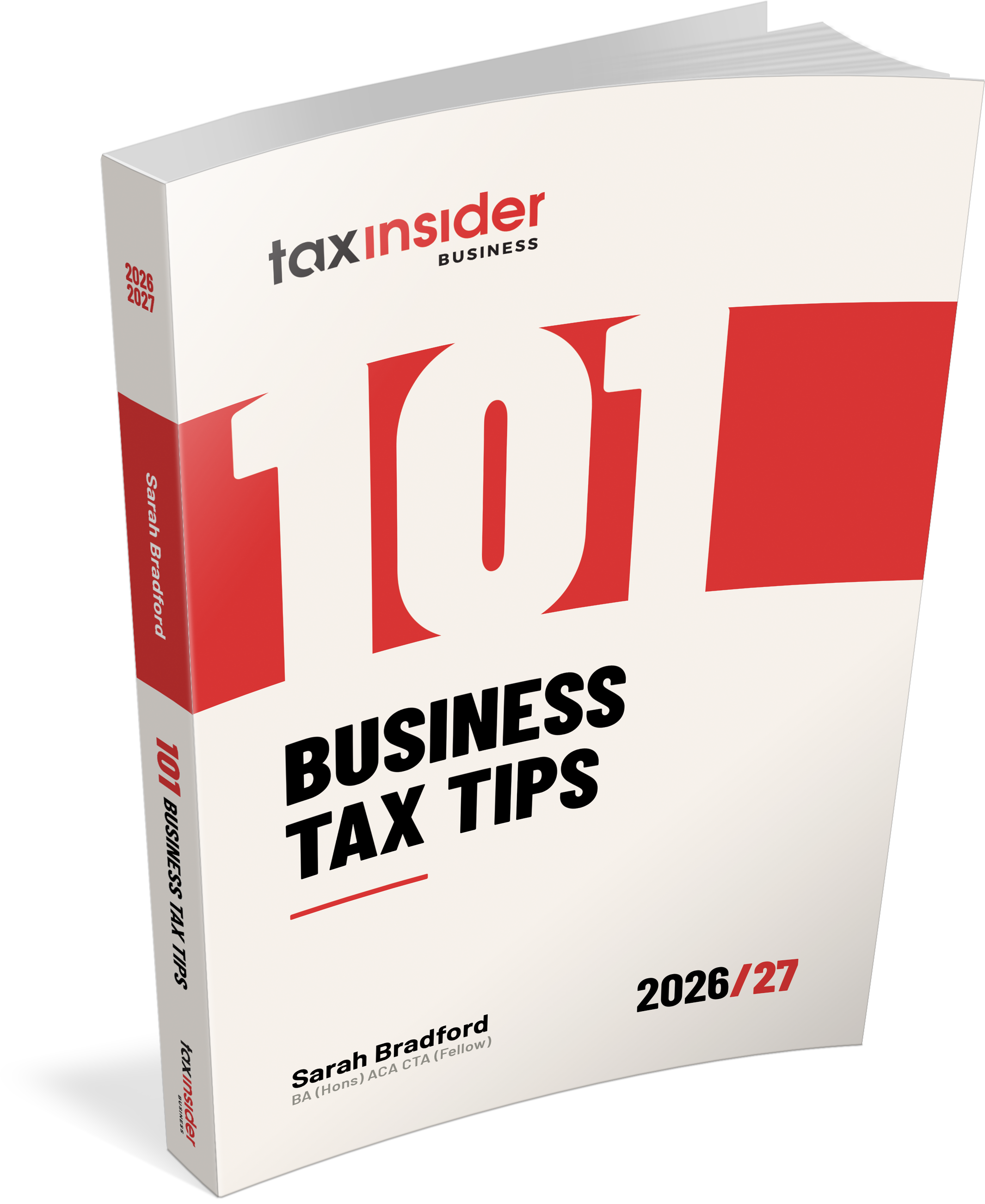
Brand New 2026/27 Edition
Business Tax Tips for Entrepreneurs and Business Owners
By Sarah Bradford BA (Hons), FCA, CTA (Fellow)
101 Business Tax Tips brings together 101 practical tax-saving tips for entrepreneurs and business owners. The tips follow the lifecycle of a business, from choosing a structure and raising finance to claiming expenses and capital allowances, extracting profits, using losses and planning an exit.
Whether you're running your own business or advising clients, it gives you the latest planning ideas at your fingertips — clearly explained, properly worked through, and ready to apply. Written by business tax specialist Sarah Bradford and now in its 13th edition, this is the go-to quick-reference guide used by business owners, accountants, tax advisers and bookkeepers across the UK.
What Taxes Does a Business Pay?
The taxes a business pays depend on its structure. Sole traders and the partners in a partnership or limited liability partnership (LLP) pay income tax on their profits, plus Class 4 National Insurance contributions where those profits exceed the lower profits limit. A limited company pays corporation tax in its own right, at between 19% and 25% for the financial year 2026, depending on the level of its profits.
Profits taken out of a company are then taxed on the people who receive them. Salary and bonuses may attract income tax and Class 1 National Insurance but are deductible for corporation tax, while dividends are paid out of retained profits and are taxed at the dividend rates once the dividend allowance and any unused personal allowance are used up. Any business with VATable turnover above the £90,000 registration threshold must also register for VAT and comply with Making Tax Digital.
Common Business Tax Mistakes and Missed Reliefs
Many of the savings are simple but easily missed. Overlooking allowable business expenses means paying more tax than you need to, capital allowances must be claimed within the time limit, and a loss relieved in the wrong way can waste a personal allowance or secure relief at 20% when 40% was available. Some reliefs need planning well ahead: the conditions for business asset disposal relief must be met throughout a two-year qualifying period.
Mistakes can also be costly. Failing to notify HMRC on time can trigger late notification penalties, paying PAYE late more than once in a tax year attracts penalties, and treating private spending as a business expense, in the belief that you can ‘put expenses through the business’, may trigger an enquiry into your accounts, with interest and penalties on any tax underpaid.
101 Business Tax Tips is a practical, plain-English guide you can act on without wading through legislation — clear tips, worked examples and real savings across the full business lifecycle.
What This Book Covers
Across nine chapters and over 200 pages, fully updated for the 2026/27 tax year with the latest rates, allowances, corporation tax thresholds, identity verification rules and Making Tax Digital requirements, the tips follow the full business lifecycle, so there's something relevant for every situation:
- Business structures — sole trader vs partnership vs LLP vs limited company, alphabet shares, incorporation
- Finance & investment — SEIS, EIS, VCT, tax relief on loans
- Early years — VAT registration choices, cash vs accruals, loss relief, pre-trading expenditure
- Business expenses — allowable deductions, dual-purpose expenses, home office, travel
- Capital allowances — full expensing, AIA, 50% FYA, electric vehicles, short-life assets
- Extracting profits from a family company — optimal salary, dividend strategies, the EA, director's loans
- Employing people, using losses, and exit planning — including Business Asset Disposal Relief and gift hold-over relief
- Plus more...
Business structure, finance and investment
How the choice between sole trader, partnership, LLP and limited company decides the taxes you pay, your liability for business debts and your administration, including the identity verification required from November 2025 of anyone running, owning or controlling a company. It also shows how an alphabet share structure allows different dividends for different shareholders, how to secure tax relief for interest when you borrow to lend to a close company or to buy partnership assets, and how the SEIS, EIS and VCT schemes help companies attract investors.
The early years
Registering with HMRC on time, choosing your accounting date and with it your corporation tax payment date, registering for VAT voluntarily, and when the VAT flat rate scheme saves work and when it may not suit a limited cost business. It also compares the cash basis, now the default for unincorporated businesses, with the accruals basis, and covers the options for relieving early year losses and relief for pre-trading expenditure.
Deductions for business expenses
The wholly and exclusively rule, dual-purpose expenses and the common expenses that are easily overlooked. You will see when mileage rates save work and when actual costs give a bigger deduction, how to claim for a home office, and the capital gains tax point to watch where a room is used exclusively for business. Travel, training, entertaining, business gifts, bad debts, professional subscriptions, loan finance costs and key person insurance are covered too, along with why private expenditure should never be treated as a business expense.
Capital allowances
Relief for capital expenditure under the cash basis and, where the accruals basis is used, through capital allowances: the £1 million annual investment allowance, the new 40% first-year allowance from 1 January 2026, full expensing and the 50% first-year allowance for companies, and writing down allowances at the main rate of 14% from April 2026. It also covers tailoring a claim, timing expenditure around the year end, lower emission and zero emission cars, electric vehicle charge points, short life assets and small pools.
Extracting profits from a family company
The optimal salary for 2026/27 with and without the employment allowance and for under 21s, how to secure a qualifying year for the state pension, and salary versus dividends at the 2026/27 rates. It also covers the dividend allowance, alphabet shares, the timing of dividends, extracting or accumulating profits, employing family members and the National Living Wage trap, pension contributions, tax-free benefits, loans to directors and the section 455 charge, loans written off and extracting profits as rent.
Employing people, using losses and exit planning
Paying PAYE and filing returns on time, and why salary sacrifice now works for only a handful of exempt benefits. The guide then sets out the loss relief options for the self-employed and for companies, and closes with the end of the business: planning your exit, business asset disposal relief at 18% for 2026/27 up to the £1 million lifetime limit, gift hold-over relief, accelerating transition profits and a bonus tip on terminal loss relief.
Who Will Benefit From This Book?
This guide is for entrepreneurs and business owners at every stage, whether you are thinking of starting a business, have recently started one or are running an established business. Many of the tips apply equally to sole traders, partnerships and companies, while some are specific to a particular type of business.
For tax professionals, it's a reliable desk reference for client meetings, planning reviews and year-end conversations. Each tip is concise and technically accurate, and most are supported by a worked example — so you can find the answer, check the position and explain it to a client in minutes, not hours.
About Sarah Bradford FCA CTA
Sarah Bradford BA (Hons), FCA, CTA (Fellow) is a Chartered Accountant and Chartered Tax Adviser, and director of Writetax Ltd, a company providing technical writing services on tax and National Insurance. She writes widely on tax and National Insurance and is a regular contributor to Business Tax Insider, Property Tax Insider and Tax Insider Professional.