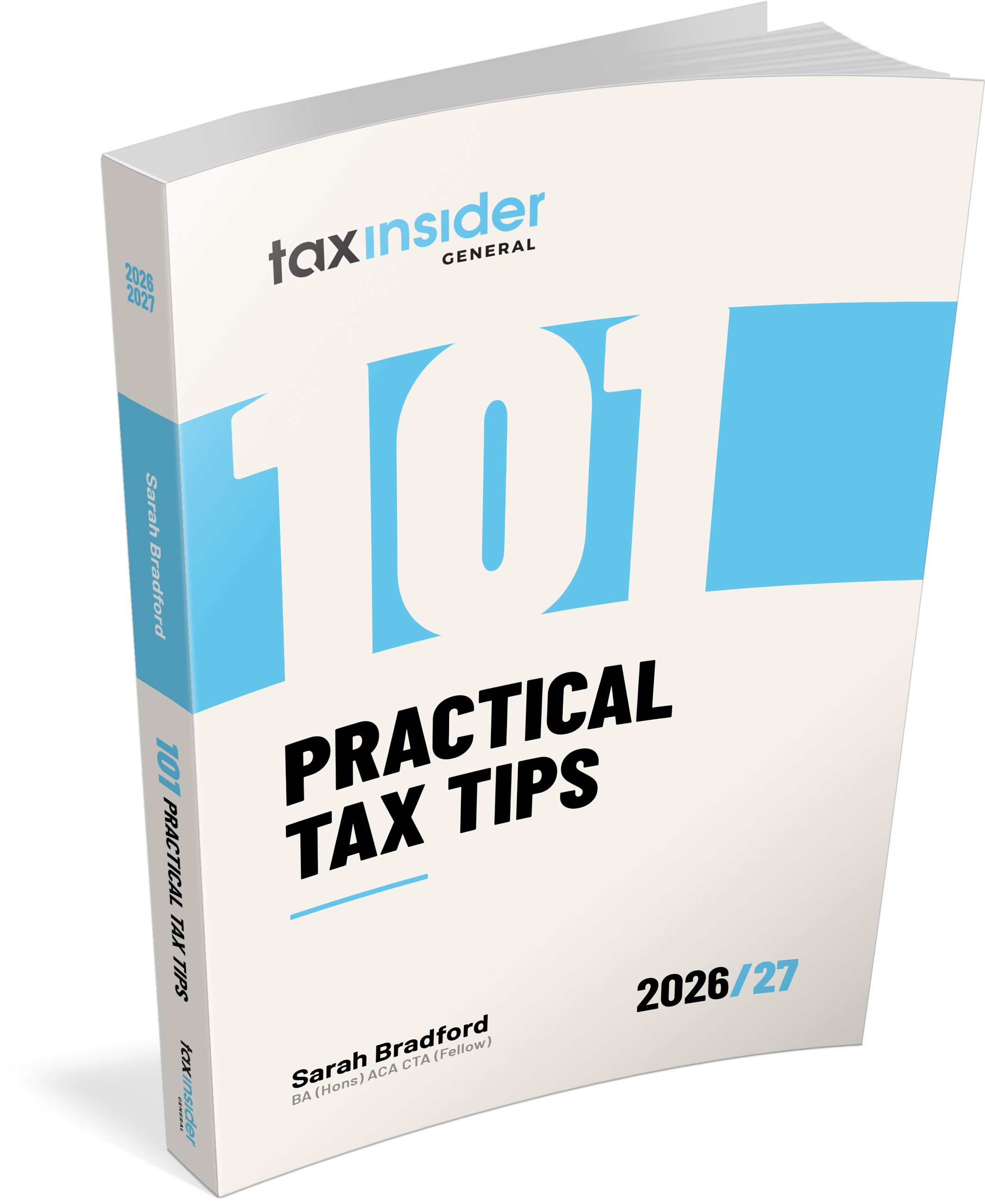
101 Practical Tax Tips for Individuals and Families
How individuals, couples and families can use their allowances and reliefs to pay less income tax, National Insurance, capital gains tax and inheritance tax.

** New 2026/27 Edition Now Available – Save 40% Today **
Practical Tax Saving Tips for UK Taxpayers
By Sarah Bradford BA (Hons), FCA, CTA (Fellow)
All taxpayers like to save tax, and there are many simple steps that can be taken to achieve this aim. Updated for the 2026/27 tax year, this guide sets out 101 of them for UK individuals, couples and families, from protecting your personal allowance and sharing allowances with a spouse or civil partner to tax-free savings, pensions, family companies, self-employment, capital gains tax and inheritance tax.
Written by tax specialist Sarah Bradford, 101 Practical Tax Tips gives you straightforward, actionable planning ideas across the full range of taxes, organised by topic and designed to be used, with worked examples throughout. First published in 2010, the guide is now in its 16th edition.
What Are Tax Allowances and Reliefs?
Tax allowances and reliefs are the amounts you can receive free of tax and the deductions that reduce the tax you pay. For 2026/27, the personal allowance lets you receive the first £12,570 of your income tax-free. On top of it come the personal savings allowance (£1,000 for basic rate and £500 for higher rate taxpayers), the £500 dividend allowance, the £3,000 annual exempt amount for capital gains tax and the £20,000 ISA allowance, while pension contributions attract tax relief at your highest rate of tax.
Each person has their own allowances, and some, such as the annual CGT exemption, are lost if they are not used in the tax year. That is why so many of the tips are about arranging income, savings and assets within a couple or family, so that each person's allowances and lower rates of tax are used rather than wasted.
Missed Allowances, Tax Traps and HMRC Penalties
Every taxpayer pays more tax than they need to. The question is knowing where to look. Some of the most expensive traps are easy to miss: the personal allowance is reduced by £1 for every £2 of adjusted net income over £100,000 and is lost entirely at £125,140, and the high income child benefit charge claws back child benefit once the recipient or their live-in partner has income of £60,000 or more, taking all of it at £80,000.
Other savings are lost simply by not acting. An unused annual CGT exemption cannot be carried forward, capital and rental losses that are not reported to HMRC cannot be set against future gains and profits, and a wrong tax code can mean paying too much tax every month. A self-assessment return filed late attracts a £100 penalty even if there is no tax to pay, with further penalties the longer it is outstanding.
What This Book Covers
In 12 chapters, plus a bonus tip on child benefit, this 200+ page guide covers the tax situations most commonly faced by our readers, including:
- Making the most of allowances and lower rates of tax — including protecting your personal allowance and using the marriage allowance
- Savings and investments — ISAs, pensions, the dividend allowance, VCTs, EIS and SEIS
- Family companies — optimal salary strategies, alphabet shares, profit extraction and loans to directors
- Employers and employees — company cars, salary sacrifice, expenses, PAYE and NIC savings
- The self-employed — NIC planning, accounting date choices, cash basis and whether to incorporate
- Losses — trading losses, capital losses, rental losses and the income tax relief cap
- Capital allowances — AIA, full expensing, FYAs and timing of capital expenditure
- VAT — voluntary registration, cash accounting and the flat rate scheme
- Capital gains tax — timing disposals, spousal transfers and rollover relief
- Property — rent-a-room, replacement domestic items relief and principal private residence relief
- Inheritance tax — gifts out of income, PETs, wills and IHT planning
- Tax returns and administration — avoiding penalties, payments on account and tax code checks
- Plus a bonus tip
Allowances, savings and pensions
How to preserve your personal allowance by bringing adjusted net income below £100,000, claim the marriage allowance and use your spouse's or civil partner's annual CGT exemption as well as your own. The savings chapter shows how the personal savings allowance, the £5,000 starting rate for savings and ISAs work together, including the £12,000 cash ISA limit for under 65s from 6 April 2027, and covers carrying forward the pension annual allowance, the taper for high earners and the tax reliefs for VCT, EIS and SEIS investments.
Family companies
Why the optimal salary for 2026/27 is usually £12,570 whether or not the Employment Allowance is available, why further profits are generally better taken as dividends, and how an alphabet share structure lets you tailor dividends to each shareholder. It also covers timing bonus payments, loans to directors and section 455 tax, now 35.75% on loans made on or after 6 April 2026, which loans to repay first, and employing your family.
PAYE, company cars and employee benefits
For employers, the tips cover paying PAYE quarterly and on time, filing RTI returns, the Employment Allowance of up to £10,500 and the exemption for paid and reimbursed expenses. For employees, they cover claiming a deduction where your employer pays less than the approved mileage rates, choosing a low or zero emission company car, cutting the fuel benefit charge, company car or car allowance, a tax-free mobile phone, the benefits that still work through salary sacrifice and claiming relief for employment expenses.
Self-employment, losses and capital allowances
National Insurance credits and voluntary Class 2 contributions for low earners, why a 31 March accounting date saves work, the cash basis, simplified expenses and whether incorporation is still worthwhile. The losses chapter explains how to get the best relief for trading losses, the cap on income tax reliefs and why capital and rental losses should always be registered, and the capital allowances chapter covers the AIA, the new 40% first-year allowance, full expensing for companies, the 100% FYA for zero emission cars and timing your capital expenditure.
VAT, capital gains tax and property
When voluntary VAT registration, the cash accounting scheme and the flat rate scheme can help; timing disposals for capital gains tax, transfers to a spouse or civil partner, roll-over relief and negligible value claims; and, for property, rent-a-room relief of up to £7,500, the £1,000 property income allowance, replacement domestic items relief, principal private residence relief, the final period exemption and lettings relief where you share your home with a tenant.
Inheritance tax, tax returns and child benefit
Gifts out of income, making a will and potentially exempt transfers; filing your return online by 30 December so that tax of less than £3,000 can be collected through your PAYE code, avoiding late filing penalties, Time-to-Pay arrangements, checking your tax code and payments on account. The bonus tip explains the high income child benefit charge and why it is worth registering for child benefit even if you choose not to be paid it, to protect your state pension entitlement.
Who Will Benefit From This Book?
This guide is for anyone who pays tax and wants to pay less of it, whether you're employed, self-employed, a landlord, a business owner, or simply want to make sure you're not missing out. Everyone who reads it will find tips that apply to their situation. In many cases, the savings could be significant.
It is especially useful for couples and families, as so many of the tips show how to share allowances, lower rates of tax and tax-free savings between spouses, civil partners and other family members.
About Sarah Bradford FCA CTA
Sarah Bradford BA (Hons), FCA, CTA (Fellow) is a Chartered Accountant and Chartered Tax Adviser, and the director of Writetax Ltd, a company providing technical writing services on tax and National Insurance.
Sarah writes widely on tax and National Insurance and regularly contributes to Business Tax Insider, Property Tax Insider and Tax Insider Professional. She is also the author of 101 Business Tax Tips, 101 Employer and Employee Tax Tips and several Tax Insider reports, including Directors' Loan Accounts Explained and Property Company v Property Trust.
Read an excerpt from this book: Utilising Your Annual CGT Exemption.