Tax-Efficient Profit Extraction for Companies
How to take money out of your company tax-efficiently, comparing salary and bonuses, benefits in kind, dividends, pension contributions, loans and other extraction routes.
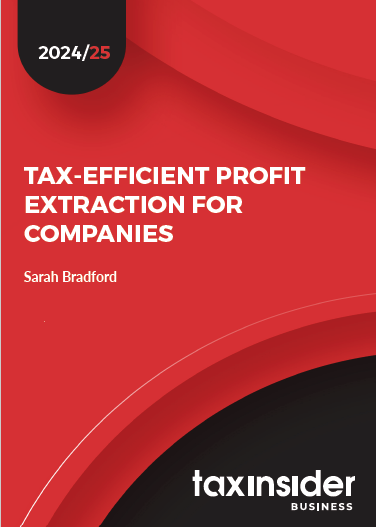


** New Tax Saving Report Released 7th May 2024 **
Tax-Efficient Profit Extraction for Limited Company Owners
By Sarah Bradford BA (Hons), FCA, CTA (Fellow)
If you run your business through a limited company, taking money out for your own use is not as simple as moving it from the business account to your personal account. Depending on how the cash is extracted, income tax and National Insurance may be due on top of the corporation tax the company pays on its profits, and not all extraction methods are equal. Tax-efficient profit extraction means choosing the right mix of salary, bonuses, benefits in kind, dividends, pension contributions and other routes, so that less of the profit is lost to tax and National Insurance.
In this special report, business tax expert Sarah Bradford explains the tax and National Insurance implications of each way of extracting cash from a company, starting with the most straightforward methods and progressing to more sophisticated ideas.
What Is Profit Extraction?
Profit extraction is the way in which the shareholders and directors of a company take its profits out for their own use. Because a company is entirely separate from its shareholders, directors and employees, this can be done in several ways: salary or bonus, benefits in kind, dividends, employer pension contributions, loans, rent, the sale of assets to the company and, at the end of the company’s life, a liquidation or a purchase of its own shares.
Each route is treated differently for tax. Salaries and bonuses are normally deductible for corporation tax, as is the employer’s National Insurance on them, but they are taxed through PAYE. Dividends attract no National Insurance, but they are paid out of profits that have already suffered corporation tax and can only be paid if the company has sufficient retained profits.
Salary or Dividends? Why the Right Mix Matters
Every year businesses review their financial strategies to make sure they’re taking advantage of the latest tax rates, breaks and allowances. This is time well spent when businesses get it right, as they can save a significant amount of money on their taxes.
The traditional route has been to take a small salary and extract further profits as dividends, but this strategy may not suit everyone. Whether a salary, bonus or dividend works out best depends on whether the personal allowance and dividend allowance are available, whether the company can claim the National Insurance employment allowance, the director’s marginal rate of tax, how much is being paid out and the rate at which the company pays corporation tax. As the report’s worked examples show, it should not be assumed that a dividend will always be better.
There are traps for the unwary, too. Most tax exemptions for benefits in kind are lost if the benefit is provided through salary sacrifice, dividends must be paid in proportion to shareholdings unless the share structure allows otherwise, and a close company loan to a shareholder that is not repaid within nine months and one day of the end of the accounting period triggers a section 455 tax charge. There is no substitute for crunching the numbers.
What This Report Covers
In 11 sections, with six worked examples, comparison tables and practical tips throughout, this in-depth report covers:
- Salary and bonus
- Salary sacrifice
- Benefit in kind
- Dividends
- Pension provision
- Loans
- Company liquidation
- Planning for spouses and civil partners
- Rent and asset sales
- Purchase of own shares
And more.
Salaries, bonuses and the optimal salary level
Why it generally makes sense to pay at least a small salary, including making the year a qualifying year for the state pension, and how the optimal salary depends on whether the personal allowance is available in full, whether the company can claim the employment allowance (not available where the sole employee is also a director) and whether a higher secondary threshold applies. The report also covers the annual earnings period for directors, when a bonus is worthwhile and the National Living Wage rules for family members who are not directors.
Benefits in kind and salary sacrifice
How benefits in kind are valued, and why a taxable benefit, which attracts employer-only Class 1A National Insurance, can still save employee’s National Insurance compared with a bonus. The report works through the most useful exemptions and low-tax options, from mobile phones, workplace meals and parking to electric company cars and vans, mileage allowance payments, trivial benefits and parties, and explains how the alternative valuation rules for salary sacrifice affect them.
Dividends and planning for spouses
How dividends are taxed, including how the dividend allowance works and why dividends are treated as the top slice of income, the need for sufficient retained profits, and how an alphabet share structure can give flexibility where paying dividends in proportion to shareholdings is not tax-efficient. A separate section looks at planning for spouses and civil partners, from using each spouse’s allowances and basic-rate band to business asset disposal relief on a sale and gifts of shares between spouses.
Pension contributions and loans
Why employer pension contributions can be a tax-efficient way to extract profits: they are normally deductible for corporation tax, carry no National Insurance and are not limited by the director’s earnings. The report also covers loans from the company, including the section 455 charge and when it is repaid, the benefit in kind on interest-free loans, the tax and National Insurance position when a loan is written off and the order in which loans should be repaid.
Rent and asset sales
Charging the company rent for premises owned by a shareholder, or for a home office, is another way to extract profits and no National Insurance is payable on it, but the rent must not be more than would be paid in the open market. The report explains the knock-on effects for business asset disposal relief and business property relief, the stamp duty land tax cost of selling the premises to the company instead, and the main residence relief point to watch when a room at home is used for the business.
Liquidation and purchase of own shares
How extracting cash on a liquidation can give capital gains tax treatment, the conditions for business asset disposal relief, the difference between a formal liquidation and a dissolution through Companies House, and the anti-avoidance rules that can treat the gain as income. The report closes with the conditions for a company’s purchase of its own shares to be taxed as a capital gain rather than a distribution, and why HMRC clearance is advisable.
Who Will Benefit From This Report?
If you are a business owner or director of a limited company of any size and want the most efficient remuneration strategy for taking money out of your company, this guide is for you. The report focuses on personal and family companies, where the shareholders are also the directors or are associated with them, for example as a spouse, civil partner or child.
The report is also popular with accountants and tax professionals, giving an in-depth understanding of the tax implications of extracting cash from a company for their clients.
About Sarah Bradford FCA CTA
Sarah Bradford BA (Hons), FCA, CTA (Fellow) is a Chartered Accountant and Chartered Tax Adviser. She is the director of Writetax Ltd, a company providing technical writing services on tax and National Insurance.
Sarah writes widely on tax and National Insurance and contributes regularly to Business Tax Insider, Property Tax Insider and Tax Insider Professional. She is also the author of several other Tax Insider guides, including Tax Planning for Family Companies, Directors’ Loan Accounts Explained, How To Maximise Deductions for Business Expenses, 101 Business Tax Tips and 101 Practical Tax Tips.