101 Property Tax Tips
Practical, legitimate ways to reduce the tax on UK property at every stage, from buying and letting to selling, gifting and passing it on.
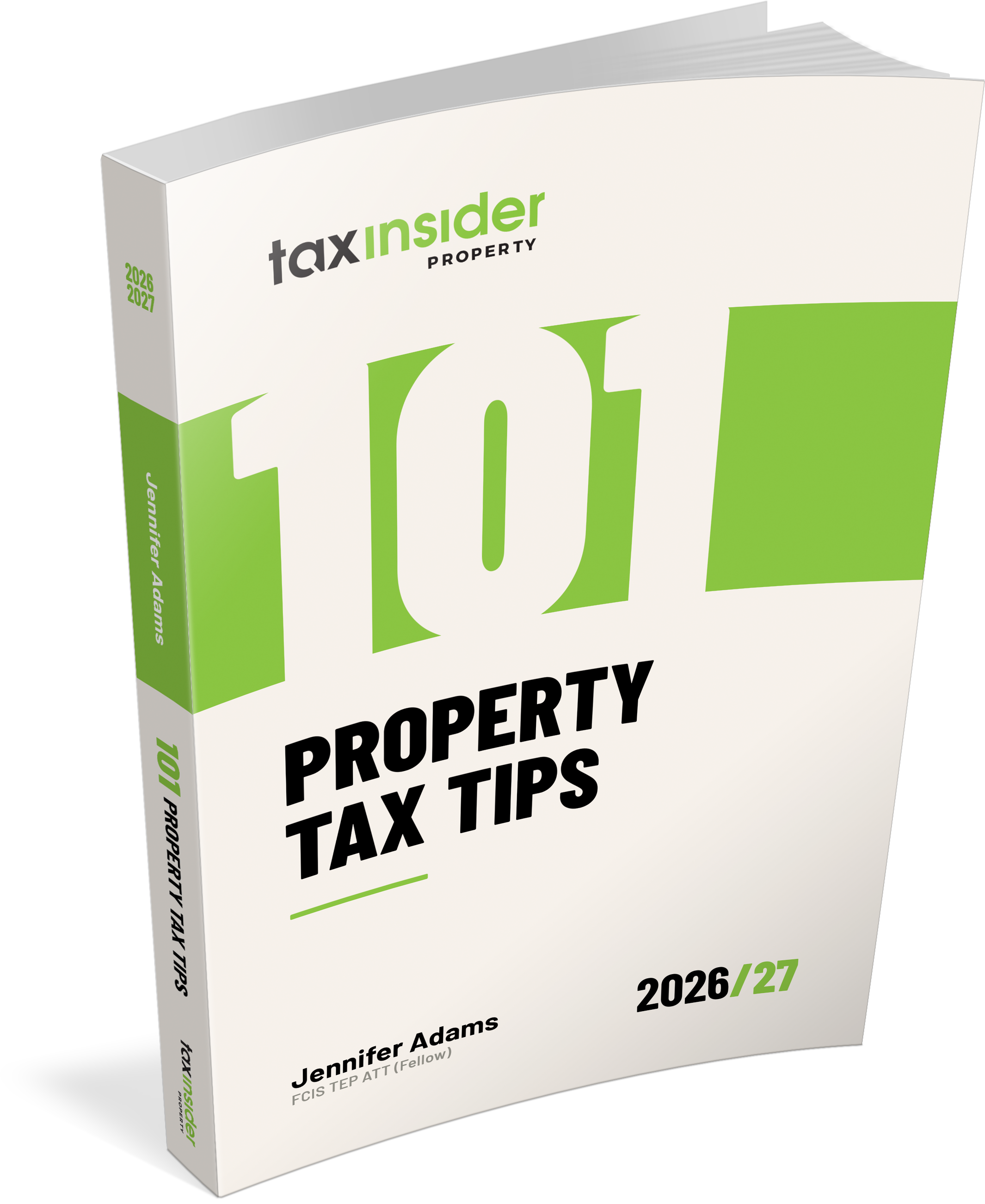

** Brand New 2026/27 Edition Now Available - Save 40% Today **
Property Tax Tips for Landlords, Investors and Developers
By Jennifer Adams
All UK property owners, whether individuals, companies, trusts or the personal representatives of an estate, and whether resident in the UK or not, will be subject to a variety of taxes on their property at some stage of ownership: from stamp duty land tax on a purchase and tax on rental profits to tax on the gain when a property is sold and inheritance tax when it is passed on. With careful planning, there are legitimate ways to reduce the overall tax bill significantly.
Written by property tax specialist Jennifer Adams, 101 Property Tax Tips sets out 101 practical tax-saving tips and strategies across the whole property lifecycle, from choosing how to own a property and preparing the letting accounts to selling, gifting and passing it on. Whether the reader is a landlord, a property developer or owns a property as a main residence, there are tax-saving tips and ideas for everyone.
What Taxes Do Property Owners Pay?
Individual landlords pay income tax on their rental profits after deducting allowable expenses, while companies pay corporation tax on their profits and gains. Capital gains tax may be due when a property that is not a main residence is sold at a profit and, for a residential property, it must be reported and paid to HMRC within 60 days of completion.
Stamp duty land tax may be payable on a purchase (land and buildings transaction tax in Scotland, land transaction tax in Wales), and inheritance tax may apply to the value of property held at death, or to a gift if the donor does not survive seven years. VAT is generally not charged on standard residential lettings, but it may be due on commercial property or where the owner is trading as a property developer, and companies owning residential property worth more than £500,000 may also face the annual tax on enveloped dwellings.
Why Property Tax Planning Matters
All property investors are likely to find themselves subject to more than one tax during the life of their property business. However, there is much that can be done to save or at least reduce the amount of tax payable, and 101 Property Tax Tips can help you to do just that.
The rules keep changing. Individual landlords of residential property receive only a 20% basic rate tax credit for mortgage interest, rather than a full deduction. Making Tax Digital for income tax has applied since 6 April 2026 to landlords and sole traders with combined gross income over £50,000, with quarterly updates and a final declaration replacing the annual tax return, and it extends to income over £30,000 from April 2027 and over £20,000 from April 2028. From 6 April 2027, income tax rates on property income rise by two percentage points, to 22%, 42% and 47%.
Small mistakes can also be costly. In one tribunal case, a claim for an estimated £40,000 of improvement costs was disallowed because there was no proof of what had actually been spent, and a Form 17 declaration of beneficial interests between spouses or civil partners is invalid if it is not filed with HMRC within 60 days of the last signature.
What This Book Covers
The 2026/27 edition, correct at May 2026 and including measures in the Finance Act 2026, sets out 101 tips plus a bonus tip in 11 chapters and more than 200 pages, with examples throughout, focusing on the following key areas:
- Different Ways Of Owning Property
- Rental Income Taxes
- Maximising Capital Allowances
- Tax Tips When Selling Property
- Foreign Tax Matters
- Maximising Main Residence Relief
- Tax Considerations When Gifting Property
- Inheritance Tax Planning
- The Use Of Trusts
- Plus Much More…
Different ways of owning property
The advantages and disadvantages of owning property personally, jointly, through a partnership, or through a limited company or LLP, and the use of ‘special purpose vehicle’ and management companies. The chapter explains how HMRC decides whether you are a trader or an investor, what happens when a property moves between trading stock and investment, and how joint owners can allocate rental profit, including when a Form 17 declaration helps spouses and civil partners and when it must not be signed.
Rental income, expenses and Making Tax Digital
Record-keeping, the Making Tax Digital timetable, penalty points and late payment rules, and when the cash basis applies. The chapter then works through what landlords can deduct: car costs, legal fees and loan finance costs, the tax credit for loan interest and how unrelieved interest is carried forward, repairs versus improvements, pre-letting expenses incurred up to seven years before the rental business starts, ‘replacement furniture’ relief, ‘rent-a-room’ relief and the £1,000 property allowance. It also covers deposits and lease premiums, extracting capital by remortgaging and uncommercial lettings.
Capital allowances, losses and non-resident landlords
When capital allowances can be claimed, including the annual investment allowance, full expensing for companies, the 40% first-year allowance from 1 January 2026, the structures and buildings allowance and the ‘special rate’ pool for integral features, plus the s198 election needed when a commercial property is sold. The book also explains how rental losses are pooled and carried forward, sideways relief for excess capital allowances, the loss relief ‘cap’, dormant periods and negligible value claims, and how the Non-Resident Landlord Scheme works for agents and tenants.
Selling property and main residence relief
How capital gains tax is charged and reported, including the 60-day deadline and its penalties, the market value rule for deals not made at ‘arm’s length’, lettings relief and business asset disposal relief. The main residence relief chapter covers the final nine months’ exemption, what counts as a residence and how to prove it, the 90-midnights test for non-residents and overseas homes, ‘flipping’ elections, delays in moving in, ‘deemed’ occupation during absences, job-related accommodation, the ‘permitted area’ of garden and working from home.
Gifting property, inheritance tax and trusts
Gifts between spouses and civil partners, transfers on separation, exchanges of interests, ‘value shifting’, ‘hold-over’ relief and incorporation relief when a letting business moves into a company. The inheritance tax chapter covers the nil rate band and residence nil rate band (including downsizing), ‘related property’, gifts with reservation of benefit, the pre-owned assets tax and planning when selling or gifting the main residence, while the trusts chapter looks at interest in possession, ‘nil rate band’ and ‘charge’ trusts and how hold-over relief interacts with main residence relief.
Stamp duty land tax, ATED, VAT and property development
Stamp duty land tax for individuals and companies, including the 17% flat rate on residential property over £500,000 bought by a company and the reliefs from it, linked transactions between connected persons, and the annual tax on enveloped dwellings. The final chapter also looks at the 5% VAT rate for renovations, VAT for developers and DIY builders, the cost of taking a property out of a company, advance clearances from HMRC, and the taxes on property development, including the £2.5 million cap on 100% business property relief from 6 April 2026.
Who Will Benefit From This Book?
This guide is for landlords, property investors and developers, letting agents, financial advisers or indeed anyone involved in any aspect of a property business who needs to familiarise themselves with the rules on property taxes. It also covers the reliefs available to anyone who owns a property as their main residence.
It is also popular with accountants and tax practitioners.
About Jennifer Adams
Jennifer Adams TEP ATT (Fellow) FCG has been a professional business author for over 25 years, specialising in property tax. She is the proprietor of her own accountancy firm and owns a portfolio of properties, so she is well placed to advise on the tax problems that landlords may face. Jennifer is a regular contributor to Tax Insider and Property Tax Insider.
101 Property Tax Tips was first published in November 2012, as ‘101 Property Tax Secrets Revealed’ and later ‘101 Tax Tips for Landlords’, and the 2026/27 edition is its 13th.
Read an excerpt from this book: Different Ways Of Owning Property.